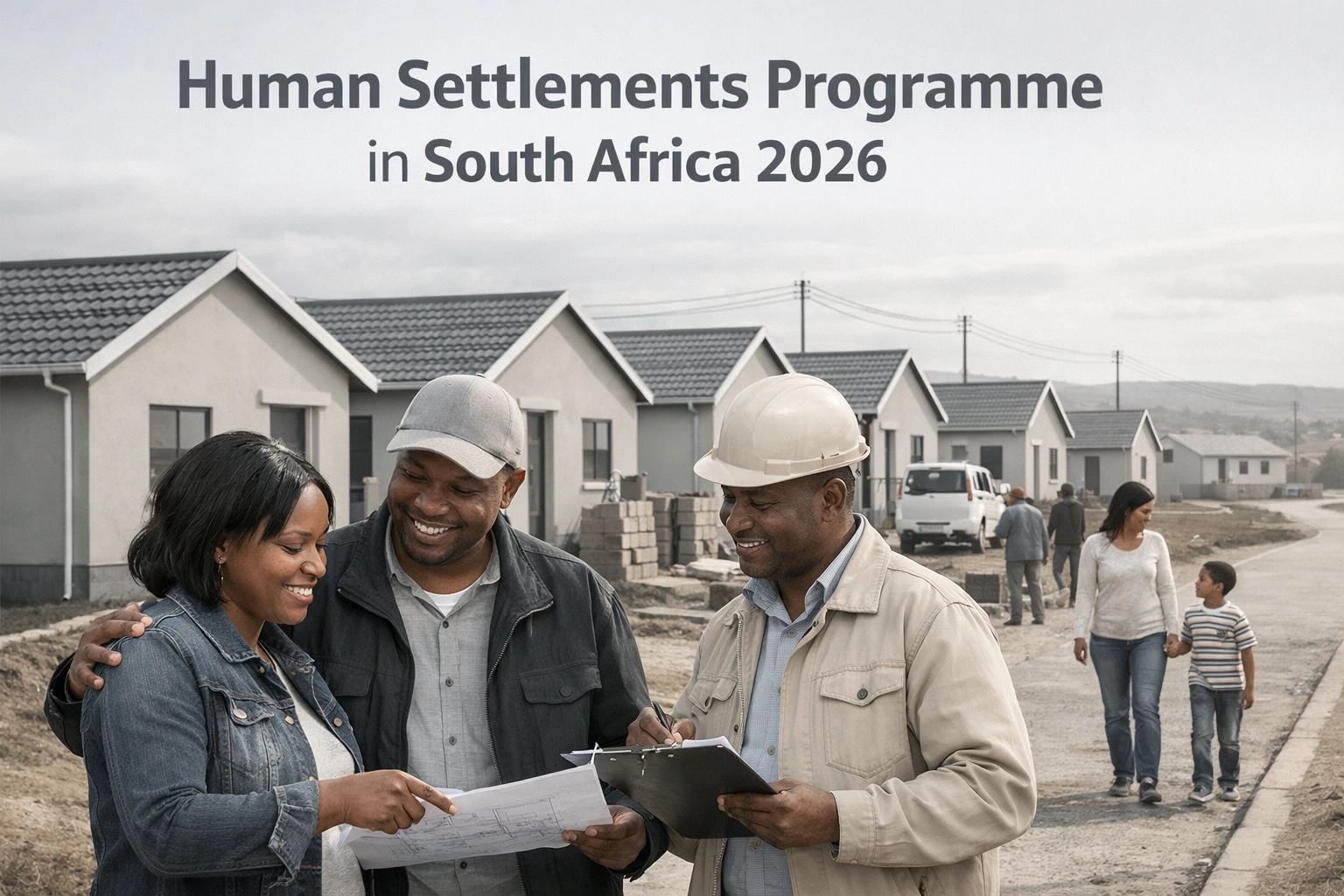
Human Settlements Programme in South Africa 2026 remains one of the most important pathways for low-income households seeking housing support, but it is also one of the most misunderstood. Every year, thousands of people search for “apply online now” links, only to land on recycled posts, outdated instructions, or outright scams. In reality, government housing assistance is still active in 2026, but the application route depends on the specific programme and, for subsidised housing, usually starts with your municipality rather than a single national online form.
For families living in overcrowded homes, informal settlements, backyard rooms, or unstable rental arrangements, that difference matters. Knowing the correct process can save time, reduce frustration, and help you avoid fake “fast-track” promises. This guide explains what the Human Settlements Programme in South Africa 2026 includes, which housing opportunities still exist, who qualifies, how waiting lists actually work, and where to use official channels only.
What the Human Settlements Programme in South Africa 2026 actually means
The Human Settlements Programme in South Africa 2026 is not a single grant or one once-off application. It is a broad housing support system administered through national, provincial, and municipal structures. The Department of Human Settlements says its mandate includes supporting access to adequate housing, while the National Housing Code remains the policy basis for the subsidy instruments used across the country. Waiting lists are locally driven, which is why the process can vary from one municipality to another.
In practice, this means there is no one universal housing application for every South African household. The system includes fully subsidised ownership opportunities, support for first-time buyers in the gap market, affordable rental options in designated urban areas, upgrading initiatives in informal settlements, and community residential programmes for rental stock that stays in public ownership.
The main housing opportunities still available in 2026
The best-known option is subsidised housing, often still called an RDP house, although policy language now commonly refers to Breaking New Ground, or BNG, housing. This remains aimed at qualifying lower-income households who need state-supported ownership. Government and provincial guidance still places the classic fully subsidised category around households earning up to about R3,500 per month, subject to programme rules and verification.
Another major option is First Home Finance, previously known to many people as FLISP. This is designed for the “gap market” — households that earn too much for fully subsidised housing but still struggle to buy or build a home without assistance. The NHFC describes First Home Finance as a once-off housing finance subsidy, and Department of Human Settlements material places the broad qualifying income band at about R3,501 to R22,000 per month.
A third route is social housing. This is not free ownership housing. It is affordable rental housing managed through approved social housing institutions in designated restructuring areas. The Social Housing Regulatory Authority states that social housing is targeted at low- to medium-income households, with the income band currently given as roughly R1,850 to R22,000 per month.
There are also programmes focused on informal settlement upgrading and community residential units, including the upgrading of publicly owned communal rental accommodation such as hostels. That matters because not every qualifying household moves directly into a newly built house. In many parts of South Africa, upgrading and rental interventions form a major part of actual delivery.
Why “apply online now” posts are often misleading
One of the biggest problems around the Human Settlements Programme in South Africa 2026 is misinformation. Many websites and social posts suggest there is one national online form where anyone can instantly apply for an RDP or Human Settlements house. That is usually misleading.
What is true is that the Department of Human Settlements is active, housing support programmes continue, the subsidy administration system is online, and First Home Finance applications are still being processed. On 12 March 2026, the NHFC even issued a public statement correcting social media misinformation and confirming that qualifying First Home Finance applications were still being processed within available funding.
What is often false is the promise that first-time subsidised housing can always be completed through one national “apply now” portal. The HSS Online system allows the public to search subsidy status and access related systems, but first-time subsidised housing registration is still typically handled through municipal or provincial channels. The Department’s FAQ also states that waiting lists are locally driven initiatives and waiting periods differ by municipality.
That local structure is why one city may require in-person registration, another may use a city housing register, and another may combine office applications with database verification. For example, Tshwane directs residents to register on the housing register, and Cape Town maintains a public housing database status-check tool.
Who qualifies for government housing support
For classic subsidised housing such as BNG opportunities, applicants generally need to be South African citizens or permanent residents, at least 18 years old, legally competent to contract, and first-time beneficiaries who have not previously received a government housing subsidy. Provincial guidance also commonly requires that the applicant be married, living with a partner, or single with financial dependants, while some categories such as military veterans and older persons may qualify under special conditions.
Income remains one of the most important filters. Official provincial and government sources continue to use the fully subsidised threshold of about R3,500 household income per month for the classic low-income category. Applicants generally should also not already own residential property.
Priority status can matter a lot. In practice, municipalities and provincial departments may prioritise older persons, people living with disabilities, military veterans, people living in informal settlements, and other vulnerable households. But qualifying does not mean you will receive a house immediately. In most cases, it means you can be registered and considered on the local housing demand database or waiting list.
Documents you should prepare before applying
A strong application starts with complete paperwork. Most municipalities and provincial departments will expect a certified copy of your South African ID, birth certificates for dependants, proof of income or an affidavit if unemployed, proof of marital status where relevant, proof of residence, and the official housing application form used by the municipality or province.
Depending on your situation, you may also need disability confirmation, a divorce order, a death certificate of a spouse, or supporting documents linked to military veteran status or other priority categories. Certified documents should be current, readable, and consistent with the details on your form. Incomplete or outdated documents are one of the biggest reasons applications are delayed.
How the correct application process works in 2026
For most first-time subsidised housing applicants, the correct first step is to register on the municipal housing demand database or housing needs register. The National Housing Needs Register exists as a central housing-needs database concept, but municipalities remain the front door for many applicants. Tshwane still directs residents to register on the National Housing Needs Register, and Ekurhuleni’s housing guidance explains that applicants are registered on the municipal housing demand database after completing the required process.
After that, you usually complete the relevant housing application form and submit your supporting documents. Officials then verify identity, income, previous subsidy history, and household circumstances. In some cases, the verification stage may include database checks and home visits. If your application is accepted, you are placed on the local waiting list or demand database.
This is the part many people misunderstand: being registered does not mean you have already been allocated a house. The Department’s FAQ says housing development takes time and waiting periods differ by municipality. Ekurhuleni’s public guidance similarly explains that only once a housing development is completed and you are next on the list would allocation happen, and that the wait can take many years.
How First Home Finance works differently
First Home Finance should not be confused with classic RDP or BNG housing. It is aimed at people in the gap market who want to buy or build their first home and who have qualifying finance support from an approved lender or funding arrangement. The NHFC’s guidance makes clear that the subsidy is once-off, and its FAQ notes that approved finance is central to the subsidy process.
That makes First Home Finance especially relevant for working South Africans who earn too much for a fully subsidised house but still cannot easily access home ownership on ordinary market terms. It is one of the most important parts of the Human Settlements Programme in South Africa 2026 for households stuck between low-income subsidy eligibility and full private affordability.
Why social housing deserves more attention
Social housing is often overlooked because many people focus only on ownership. But for households in urban areas, affordable rental can be the more realistic path. The SHRA says social housing is state-subsidised rental housing, aimed at low- to medium-income groups, and intended to improve access to housing near jobs, services, and transport.
That means the Human Settlements Programme in South Africa 2026 is not only about waiting for a house to be built. In some cities, affordable rental through accredited social housing providers may be more accessible than ownership, especially for households that need location, stability, and a formal rental environment close to employment.
Common mistakes that delay applications
Many valid applicants weaken their own case through avoidable mistakes. Uncertified documents are a major problem. So are wrong income declarations, incomplete forms, and phone numbers that are no longer active. Another mistake is assuming that sending an email to a general departmental address counts as formal registration. In most cases, it does not.
It is also a mistake to chase the wrong programme. Someone who qualifies for First Home Finance may spend years waiting for subsidised housing they do not actually qualify for. Someone who needs affordable rental in a city may ignore social housing and focus only on ownership. Understanding the right programme for your income and household structure can save a great deal of time.
Warning signs of housing scams
Housing scams remain common in South Africa. The safest rule is simple: government housing applications are not supposed to be sold to you by private middlemen promising quick results.
Be very cautious if someone says they can move you up the waiting list for a fee, guarantee allocation, collect “processing money” over WhatsApp, or offer an unofficial online form that is not linked to a recognised government or programme authority website. These claims do not match how the verified system works. Official waiting lists are locally managed, and legitimate programme information comes from recognised government and programme bodies.
There is no legal shortcut to jump the queue, but there are ways to strengthen your position. Apply through the correct official channel as early as possible. Submit complete and accurate documents. Keep your contact details updated every time you move or change numbers. Respond quickly when your municipality or provincial office asks for more information. And make sure you understand which programme actually fits your income and needs.
The Human Settlements Programme in South Africa 2026 remains a real and important route to housing support, but it is not a one-click national giveaway. Subsidised housing, First Home Finance, social housing, and settlement upgrading all serve different groups. The correct entry point usually depends on your municipality, your income, and your household situation.
The most important takeaway is this: if you want subsidised housing, start with official municipal or provincial channels, not random “apply now” posts. If you fall into the gap market, check First Home Finance. If you need affordable urban rental, explore social housing. And in every case, avoid paying anyone for “guaranteed” approval. That is not how the verified system works
Human Settlements Programme in South Africa 2026
Frequently Asked Questions
1. How do I apply for the Human Settlements Programme in South Africa 2026?
To apply for the Human Settlements Programme in South Africa 2026, you must register on your local municipality’s housing waiting list or housing needs register. Most first-time applications for subsidised housing are not done through a national online form but through municipal or provincial human settlements offices.
2. Who qualifies for the Human Settlements Programme in South Africa 2026?
To qualify for the Human Settlements Programme in South Africa 2026, applicants must be South African citizens or permanent residents, over 18 years old, and earning below the required income threshold (usually under R3,500 per month for fully subsidised housing). Applicants must also not have previously received a housing subsidy or own property.
3. Is there an online application for RDP houses in 2026?
There is no single national online application portal for RDP or BNG houses under the Human Settlements Programme in South Africa 2026. Most applications must be completed through municipalities. Online systems like HSS are mainly used for checking application status rather than submitting first-time applications.
4. How long does it take to get a house through the Human Settlements Programme?
The waiting period for the Human Settlements Programme in South Africa 2026 can vary from a few months to several years. Allocation depends on factors such as available housing projects, your position on the waiting list, and whether you fall into a priority group.
5. Can I pay someone to speed up my housing application?
No. You should never pay anyone to speed up your application for the Human Settlements Programme in South Africa 2026. Government housing applications are free, and any request for payment is a red flag for scams. Always apply through official municipal or government channels.
Nonhlanhla Ndlovu is the founder and publisher of EduFeeds, a South Africa–focused platform that shares verified learnerships, internships, bursaries, and job opportunities for young people and job seekers.
With a strong focus on helping South African youth access real career opportunities, Nonhlanhla researches and verifies programmes from official company sources and public announcements before publication. EduFeeds aims to simplify the application process by providing clear guidance, requirements, and practical tips to help applicants apply with confidence.
Nonhlanhla continues to monitor updates from SETAs, companies, and training providers to ensure information on Edu Feeds remains current and useful. She focuses on publishing timely and accurate opportunity updates for the South African youth employment market.
The Armaments Corporation of South Africa (Armscor), in partnership with the South African defence industry, has officially opened applications for its Bursary Programme for the 2026 academic year. This prestigious bursary targets academically strong South African students pursuing critical science, engineering, and technology qualifications needed to support the future of the country’s defence and security…
For many South African graduates, the journey beyond an honours degree ends not because of a lack of ability, but because of funding. Master’s and PhD studies remain out of reach for thousands of capable students who cannot afford tuition, accommodation, or research costs. In a country facing serious skills shortages in critical sectors, this…
NSFAS Funding 2026: What Students Need to Know Now NSFAS Funding 2026 continues to play a major role in helping South African students access higher education. For many families, financial support from the National Student Financial Aid Scheme makes it possible for students to register at universities or TVET colleges and complete their studies. Every…
Letaba TVET College Learnerships 2026 and ARPL Trade Programmes: What to Know Before You Submit (110 Posts) Letaba TVET College has announced two skills programmes for 2026 in Limpopo: a CHIETA-funded Painter Learnership (12 months) and an FP&M SETA ARPL Trade Programme (4 months). Together, they add up to 110 posts—but they are aimed at…
NYDA Funding 2026: Who Qualifies and How to Apply for Up to R100 000 If you’re a young entrepreneur struggling to raise capital, NYDA Funding 2026 may be one of the most realistic opportunities available in South Africa right now. The National Youth Development Agency (NYDA) continues to provide grant funding to youth-owned businesses —…
Introduction For many South African students, pursuing a degree in engineering or science is often limited by financial constraints rather than academic ability. Tuition fees, accommodation, study materials, and living costs can quickly become barriers to accessing higher education. Bursary programmes play a critical role in addressing this gap. They not only provide financial support…