Government Launches New Digital System for Early Childhood Development Registration
South Africa is rolling out a new digital system designed to simplify the registration process for Early Childhood Development (ECD) programmes across the country.
The new platform, called EduPage, forms part of the Bana Pele ECD Registration Drive, a national effort aimed at improving the quality, safety, and accessibility of early childhood services.
The initiative is being implemented with support from the Department of Basic Education, which oversees the country’s early learning policy framework.
Officials say the digital platform will make it easier for ECD centres—particularly those operating in under-resourced communities—to register formally and comply with national standards.
Early childhood development is widely recognised as one of the most important foundations for education and long-term social development.
Why Early Childhood Development Is a National Priority
Early childhood education has become a key policy focus in South Africa as government departments seek to improve educational outcomes from the earliest stages of learning.
Research consistently shows that high-quality early childhood programmes contribute to:
stronger literacy and numeracy skills
improved cognitive development
better long-term academic performance
stronger social and emotional development
However, many ECD centres operate informally and struggle to complete the registration process due to administrative and regulatory challenges.
The Bana Pele initiative aims to address this gap by bringing more ECD programmes into the national regulatory system while offering structured support for compliance.
The EduPage platform was introduced to simplify how early childhood programmes register and track their compliance progress.
Instead of navigating complex paperwork processes, ECD centres can now submit information digitally through multiple channels.
These include:
an online registration portal
a WhatsApp-based application system
digital document submission tools
The platform is designed to reduce administrative barriers and allow smaller community-based centres to participate in the national registration drive.
Officials say the system also improves data tracking, enabling authorities to better understand where ECD services are located and what support they may require.
A Three-Stage Pathway to Compliance
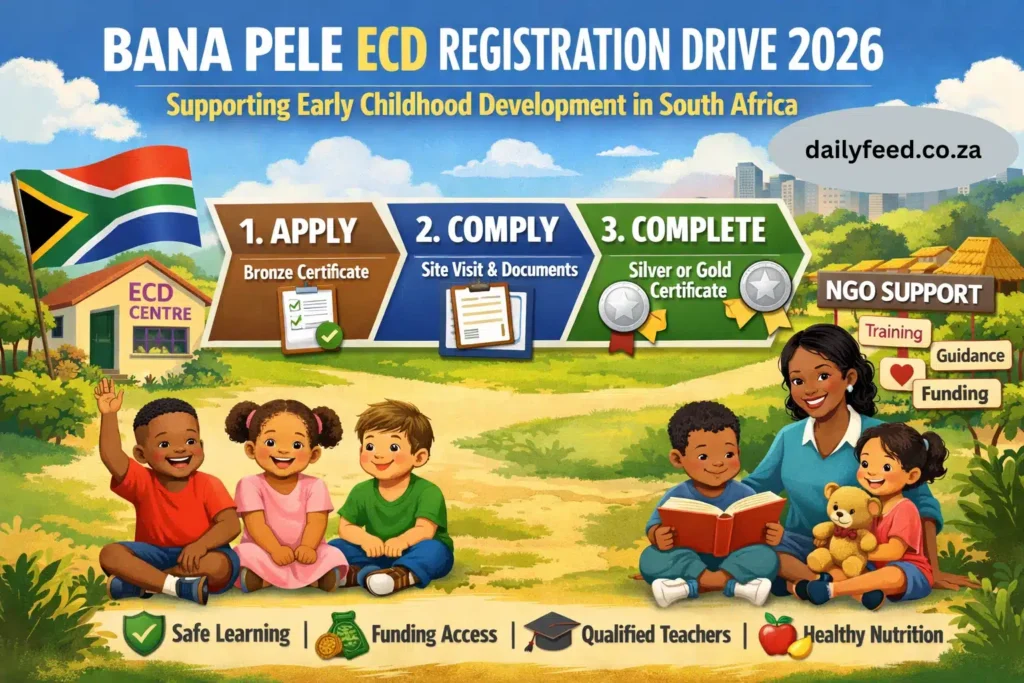
A key feature of the new registration system is a three-stage certification process that allows centres to progress gradually toward full compliance.
Rather than requiring immediate full compliance, the system recognises that many centres need time and support to meet regulatory standards.
Stage 1: APPLY
The first stage allows ECD programmes to formally enter the system.
Centres submit basic information through the EduPage platform and begin the registration journey.
Once the application is accepted, programmes receive a Bronze Certificate, acknowledging that they have joined the compliance process.
This stage focuses on accessibility and inclusion.
Stage 2: COMPLY
During the second stage, centres work toward meeting required operational and safety standards.
This stage may involve:
documentation submission
verification visits by officials
assessments of facilities and learning environments
Standards evaluated during this stage include:
health and safety conditions
child protection practices
learning programme standards
nutritional guidelines for children
Officials say this phase is designed to support improvement rather than exclude centres that need assistance.
Stage 3: COMPLETE
The final stage recognises ECD programmes that meet full compliance requirements.
Centres that successfully complete the process may receive Silver or Gold certification, reflecting higher levels of compliance and quality.
The tiered system aims to encourage continuous improvement while recognising progress made by centres.
Why the Rollout Begins in Gauteng
The digital registration system is being introduced gradually, beginning with pilot sites in Gauteng.
Pilot programmes allow officials to test the system before expanding it nationwide.
The phased rollout helps authorities:
identify technical challenges
improve platform usability
gather feedback from ECD operators
refine registration procedures
Once testing is completed, the platform is expected to be expanded to additional provinces.
Community Organisations Supporting the Programme
The Bana Pele initiative also relies heavily on partnerships with non-governmental organisations.
Many NGOs already work closely with ECD centres in communities and provide support such as:
training for ECD practitioners
compliance guidance
infrastructure support
educational resources
These organisations are expected to play an important role in assisting centres during both the APPLY and COMPLY stages of the process.
By leveraging existing community networks, the programme aims to reach centres that may otherwise struggle to access government services.
What the Programme Means for ECD Centres
For ECD practitioners and centre operators, the new system offers a clearer pathway toward formal recognition.
Benefits of registration include:
improved credibility with parents and communities
compliance with national education standards
eligibility for potential government support programmes
improved health and safety oversight
Registration also helps ensure that children attending ECD centres receive structured learning support and safe developmental environments.
By combining digital registration tools with phased compliance support, policymakers hope to bring more ECD programmes into the national system without excluding community-based providers.
If successful, the initiative could strengthen early learning infrastructure across the country and ensure that more children benefit from structured educational environments before entering formal schooling.
Early childhood development is often described as the foundation of a nation’s education system.
Improving access to safe, high-quality early learning programmes may therefore play an important role in shaping South Africa’s future workforce and social development.
If you’re a parent → Choose registered centres for your child.
If you’re an NGO → Partner with DBE to support compliance.
Together, we can ensure that every child in South Africa has the best possible start in life
EduPage
Frequently Asked Questions (FAQs)
1. What is the EduPage ECD registration system in South Africa?
The EduPage ECD registration system is a digital platform introduced by the Department of Basic Education to simplify the registration process for Early Childhood Development (ECD) centres. The platform allows ECD centres to submit applications online, upload documents, and track their compliance progress. It forms part of the Bana Pele ECD Registration Drive, which aims to help more childcare centres become officially recognised and improve early learning services across South Africa.
2. Who must register on the EduPage ECD platform?
All Early Childhood Development (ECD) centres operating in South Africa are encouraged to register through the EduPage platform. This includes: community crèches day-care centres preschool learning programmes home-based childcare providers Registration helps centres meet standards set by the Department of Basic Education and ensures children receive safe and structured early learning support.
3. What are the three stages of ECD registration under the Bana Pele programme?
The Bana Pele ECD registration system follows a three-stage compliance pathway: 1. Apply Centres submit their basic details on the EduPage platform and receive a Bronze certificate. 2. Comply ECD centres work on meeting required standards such as safety, documentation, and child protection guidelines. 3. Complete Centres that fully meet all requirements can receive Silver or Gold certification, showing higher levels of compliance. This phased system helps centres improve gradually rather than being excluded from registratio
4. Why is the Bana Pele ECD registration drive important?
national education system. Many ECD centres operate informally and struggle with complex registration procedures. By introducing digital tools like EduPage, the Department of Basic Education hopes to: improve safety standards in childcare centres expand access to early learning opportunities support ECD practitioners in underserved communities ensure better development outcomes for young children Early childhood education plays a crucial role in preparing children for formal schooling.
5. When will the EduPage ECD registration system be available nationwide?
The EduPage platform is currently being introduced through pilot programmes in Gauteng. Government officials will first test the system in selected areas to identify technical issues and improve usability. After the pilot phase, the platform is expected to expand to other provinces across South Africa. The national rollout aims to support thousands of ECD centres that still need formal registration.
Nonhlanhla Ndlovu is the founder and publisher of EduFeeds, a South Africa–focused platform that shares verified learnerships, internships, bursaries, and job opportunities for young people and job seekers.
With a strong focus on helping South African youth access real career opportunities, Nonhlanhla researches and verifies programmes from official company sources and public announcements before publication. EduFeeds aims to simplify the application process by providing clear guidance, requirements, and practical tips to help applicants apply with confidence.
Nonhlanhla continues to monitor updates from SETAs, companies, and training providers to ensure information on Edu Feeds remains current and useful. She focuses on publishing timely and accurate opportunity updates for the South African youth employment market.
Nonhlanhla Ndlovu is the founder and publisher of EduFeeds, a South Africa–focused platform that shares verified learnerships, internships, bursaries, and job opportunities for young people and job seekers.
With a strong focus on helping South African youth access real career opportunities, Nonhlanhla researches and verifies programmes from official company sources and public announcements before publication. EduFeeds aims to simplify the application process by providing clear guidance, requirements, and practical tips to help applicants apply with confidence.
Nonhlanhla continues to monitor updates from SETAs, companies, and training providers to ensure information on Edu Feeds remains current and useful. She focuses on publishing timely and accurate opportunity updates for the South African youth employment market.