Getting invited to a learnership interview is a major step toward starting your career. Many applicants submit applications for learnership programmes every year, but only a small number reach the interview stage.
How to Pass Learnership Interviews in South Africa-Overview
If you have received an interview invitation, it means the organisation already sees potential in your application.
However, many candidates fail the final stage simply because they are not prepared for the interview.
A learnership interview is designed to help employers understand your attitude, communication skills, and willingness to learn. Recruiters want to know whether you are reliable, motivated, and ready to grow in a workplace environment.
In this guide, you will learn:
How learnership interviews work in South Africa
Common interview questions employers ask
Examples of strong answers
What to wear to a learnership interview
Documents you should bring
Mistakes that often cause candidates to be rejected
Preparing properly can greatly improve your chances of being selected.
Understanding Learnership Interviews in South Africa
During the recruitment process, employers usually evaluate applicants through several stages:
Application review
Shortlisting
Interview or assessment
Final selection
The interview stage allows employers to evaluate qualities that cannot be seen on a CV, such as communication, attitude, and confidence.
Why Employers Conduct Learnership Interviews
Unlike traditional job roles, learnership programmes focus on potential rather than experience.
Employers want to identify candidates who:
are motivated to learn
can work well in a team
communicate effectively
show reliability and responsibility
Many organisations use structured interviews to evaluate these qualities.
The goal is not necessarily to find the most experienced candidate, but the person who shows the strongest willingness to learn and grow.
Common Learnership Interview Questions
Most learnership interviews include a combination of personal and behavioural questions.
These questions help employers understand your personality, motivation, and future goals.
Here are some of the most common questions.
Tell Us About Yourself
This question is usually asked at the beginning of the interview.
Employers want to hear a short summary of:
your background
your education
your interest in the opportunity
Example answer:
I recently completed my matric and I am very interested in gaining practical work experience. I enjoy learning new skills and working with others. I believe this learnership will help me develop valuable professional skills while contributing positively to the organisation.
Keep your answer short, confident, and positive.
Why Do You Want This Learnership?
Employers want to see that you understand the opportunity and are genuinely interested.
Example answer:
I want this learnership because it offers an opportunity to gain practical experience while developing industry-relevant skills. I am eager to learn, improve my abilities, and build a career in this field.
Avoid answers that focus only on needing a job. Instead, emphasise learning and development.
What Are Your Strengths?
Employers want to know what qualities you bring to the workplace.
Examples of strengths:
communication skills
teamwork
reliability
willingness to learn
problem-solving
Example answer:
One of my strengths is my ability to work well with others. During school projects I often helped coordinate tasks within our group, which helped us complete assignments successfully.
Choose strengths that relate to learning and teamwork.
What Are Your Weaknesses?
This question helps employers understand your self-awareness.
Example answer:
One area I am improving is public speaking. I sometimes feel nervous speaking in front of large groups, but I am actively working on becoming more confident.
The key is to show honesty and willingness to improve.
Where Do You See Yourself in Five Years?
Employers want to see that you have long-term goals.
Example answer:
In five years I hope to have gained valuable work experience and developed strong professional skills. I would like to continue growing in my career and possibly take on more responsibilities within the industry.
Avoid unrealistic answers.
What to Wear to a Learnership Interview
First impressions matter.
You do not need expensive clothing, but you should dress neatly and professionally.
Good options include:
For men:
clean trousers
a collared shirt
closed shoes
For women:
neat blouse or shirt
formal pants or skirt
comfortable closed shoes
Avoid:
ripped clothing
sandals
caps or hats
excessive accessories
Dressing professionally shows respect for the opportunity.
Documents to Bring to a Learnership Interview
Many candidates forget to bring the required documents to the interview.
Always carry a folder containing copies of:
South African ID
Matric certificate or latest results
Updated CV
Proof of residence
Any additional certificates
If you are unsure which documents are required, you can read our detailed guide:
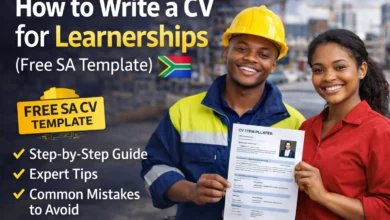
A strong CV can help you reach the interview stage faster.
How to Pass Learnership Interviews
Frequently Asked Questions
How long do learnership interviews usually take?
How long do learnership interviews usually take?
Do I need work experience for a learnership interview?
No. Learnerships are designed for people who may not yet have work experience. Employers mainly look for motivation and willingness to learn.
What should I do if I feel nervous?
Feeling nervous is normal. Take deep breaths, listen carefully to questions, and answer honestly.
Can I apply for multiple learnerships?
Yes. Many candidates apply for multiple opportunities to increase their chances of success.
What happens after the interview?
If you are selected, the organisation will usually contact you with details about the next stage, which may include training schedules or contract signing.
Final Thoughts
Learnership interviews can feel intimidating, especially if it is your first professional interview.
However, preparation can make a significant difference.
By understanding how learnership interviews work, practising common questions, and presenting yourself professionally, you can greatly improve your chances of success.
Remember that employers are not only looking for experience. They are looking for people who are motivated, responsible, and eager to learn.
With the right preparation and attitude, you can take an important step toward building your career.
Nonhlanhla Ndlovu is the founder and publisher of EduFeeds, a South Africa–focused platform that shares verified learnerships, internships, bursaries, and job opportunities for young people and job seekers.
With a strong focus on helping South African youth access real career opportunities, Nonhlanhla researches and verifies programmes from official company sources and public announcements before publication. EduFeeds aims to simplify the application process by providing clear guidance, requirements, and practical tips to help applicants apply with confidence.
Nonhlanhla continues to monitor updates from SETAs, companies, and training providers to ensure information on Edu Feeds remains current and useful. She focuses on publishing timely and accurate opportunity updates for the South African youth employment market.
Nonhlanhla Ndlovu is the founder and publisher of EduFeeds, a South Africa–focused platform that shares verified learnerships, internships, bursaries, and job opportunities for young people and job seekers.
With a strong focus on helping South African youth access real career opportunities, Nonhlanhla researches and verifies programmes from official company sources and public announcements before publication. EduFeeds aims to simplify the application process by providing clear guidance, requirements, and practical tips to help applicants apply with confidence.
Nonhlanhla continues to monitor updates from SETAs, companies, and training providers to ensure information on Edu Feeds remains current and useful. She focuses on publishing timely and accurate opportunity updates for the South African youth employment market.