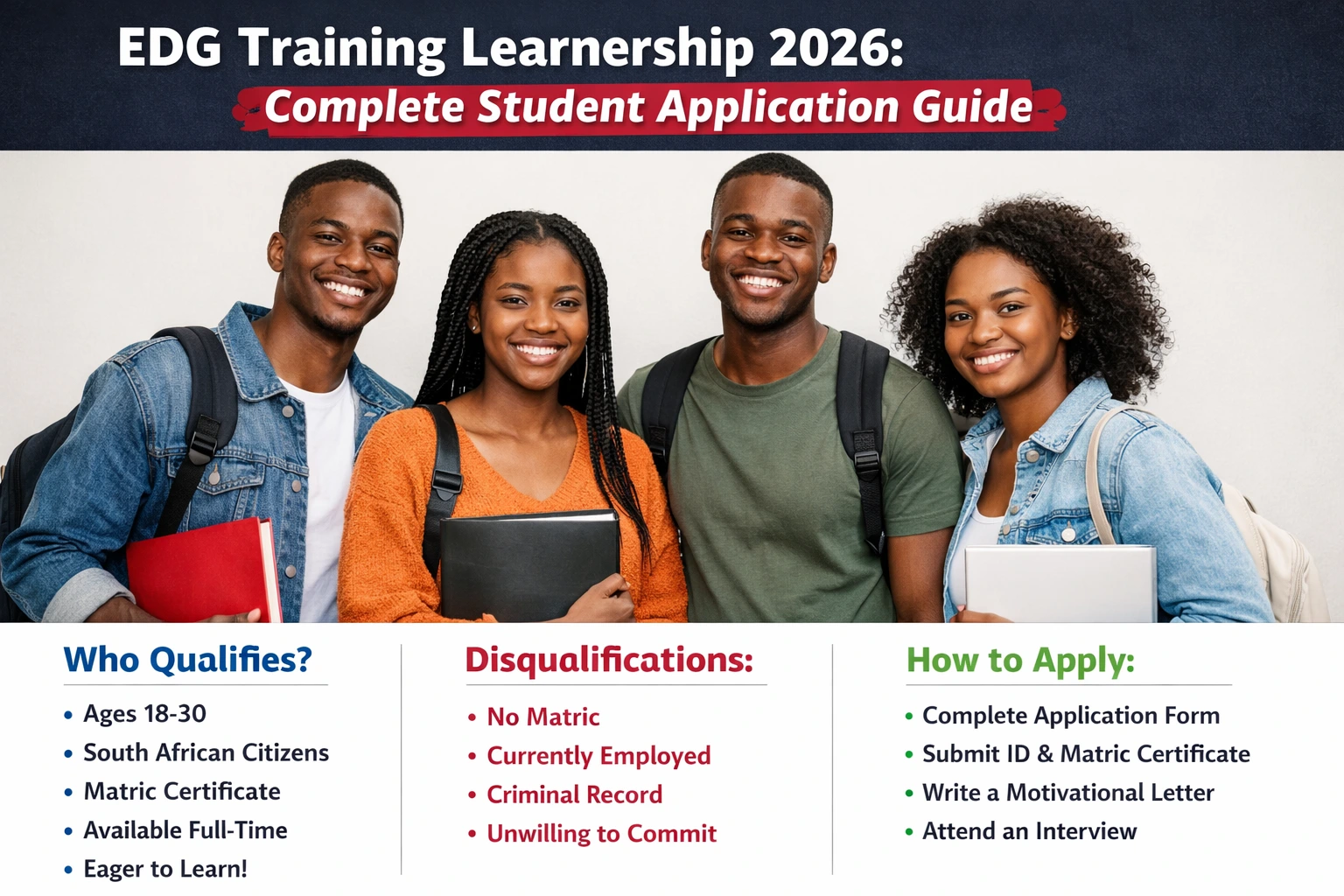
EDG Training Learnership 2026

EDG Training Learnership 2026: Complete Student Application Guide, Who Qualifies, Disqualifications + How to Apply

Applying for learnerships can feel confusing because the rules are strict, the competition is high, and many applicants get rejected for small mistakes. This EDG Training Learnership 2026 guide is written to help you apply the right way the first timeโ€”especially if youโ€™re a first-time applicant, a recent matriculant, a graduate, or a person living with a disability looking for structured workplace exposure.

This is not a โ€œcopy-paste listing.โ€ Itโ€™s a practical, student-friendly application playbook that explains what EDG/Edge-style learnership intakes usually require, how applications are processed, and how to avoid the most common reasons people get disqualified.

Youโ€™ll learn:

  • โœ… What the EDG Training Learnership 2026 application process looks like
  • โœ… Who qualifies and what โ€œstrong applicantsโ€ do differently
  • โœ… Competition level and what that means for you
  • โœ… Required documents (and why they matter)
  • โœ… The biggest disqualification traps to avoid
  • โœ… Step-by-step application strategy to increase your chances
  • โœ… FAQ at the end

ALSO APPLY FOR UPW Training Academy Learnership 2026 (ยฑR3,500/Month Allowance)


Why the EDG Training Learnership 2026 matters for applicants

Most learnership applicants are trying to solve one of these problems:

  1. No work experience
  2. No access to opportunities (especially outside major cities)
  3. Need workplace exposure for employability
  4. Need structured learning and a recognised path

A well-run learnership intake creates a bridge between education and employment by combining:

  • training aligned to a recognised qualification framework (depending on the programme), and
  • workplace exposure that helps you build a CV that employers trust.

For many people, the learnership isnโ€™t only about getting a stipend (if offered). The real long-term value is:

  • proof you can show up daily
  • proof you can complete a structured programme
  • reference-ready workplace experience
  • practical skills that match entry-level job roles

ALSO APPLY FOR TETA Learnership Programmes 2026


EDG Training Application Guide 2026: what every learner must understand

Before you apply, understand this:

1) Learnership placements are not guaranteed

Being โ€œeligibleโ€ does not mean you will be placed. Placement depends on:

  • available funded opportunities
  • employer demand
  • learnership fields open at the time
  • whether your profile matches whatโ€™s needed

2) Your application is screened like a checklist

Most training providers/partners process applications using a simple filter:

  • Are all documents included?
  • Are documents readable and certified?
  • Does the qualification match the available learnership?
  • Are tax/banking details valid where required?
  • Does the candidate meet the special criteria (e.g., disability verification) if relevant?

If you fail any โ€œmust-haveโ€ item, youโ€™re outโ€”often without feedback.

3) Small mistakes are treated as โ€œnon-complianceโ€

In learnership processes, rule-breaking is not debated. Itโ€™s usually automatic rejection.


Step-by-step: EDG Training Student Application Process 2026

This is the process most applicants should expect.

Step 1: Submit your application correctly

Most intakes require you to apply using the official Student Application Form (online form or provided document). Some providers also allow regional submissions by email.

Your #1 job: use the correct form and the correct channel.

Rule that catches many people:
โœ… Submit ONE application only.
Submitting multiple applications often triggers automatic disqualification because it creates duplicate records.

Step 2: Gather required documents (and submit them properly)

This is where most disqualifications happen.

Below are documents commonly required for student learnership intakesโ€”especially those that place candidates into funded programmes.

1) Updated CV (Curriculum Vitae)

Your CV should:

  • be 1โ€“2 pages
  • include correct contact details
  • show your education clearly
  • list skills that match entry-level roles (communication, MS Office, teamwork, time management)
  • include volunteer work or school leadership (if no experience)

Avoid: fancy graphics, colourful templates, 4-page CVs, or unprofessional email addresses.

2) Certified copy of your highest qualification

This could be:

  • Grade 12 certificate
  • Grade 11 proof of results (if accepted for a specific programme)
  • TVET certificate
  • diploma/degree transcripts (if applicable)

Important: if a learnership requires a specific level (example: Matric), applying without it can lead to immediate rejection.

3) Copy of South African ID

Your ID must be:

  • clear and readable
  • not expired/illegible
  • matching the name used on your CV and form

4) Proof of disability (if applicable)

If applying under disability criteria, you usually need a valid medical confirmation.
Do not guessโ€”submit what the intake requests.

5) SARS tax number (if requested)

Some programmes require tax details for stipend processing and compliance.

6) 3-month bank statement (if requested)

This helps confirm:

  • the account is active
  • bank details are correct
  • stipend payment can be processed if youโ€™re selected

Tip: If you donโ€™t have a bank account, open one early. This alone can block placement even when you qualify.

Document submission tips (this affects selection)

  • Use PDF where possible
  • Ensure scans are bright, clean, readable
  • Name your file properly: Name_Surname_EDG_Application.pdf
  • Avoid sending 10 separate files unless instructedโ€”combine into one PDF if allowed

Who qualifies for EDG Training Learnership 2026?

Exact eligibility depends on each programme, but typical requirements include:

  • South African citizen
  • appropriate qualification for the learnership field
  • available for the full duration (often 12 months)
  • able to attend interviews/assessments (online or in your region)
  • correct banking and tax details where required
  • persons with disabilities may be prioritised in inclusive intakes

Who qualifies strongly (what shortlisters like)

Shortlisting is not only about โ€œmeeting minimum.โ€ Strong candidates usually have:

  • a clean, error-free application pack
  • a CV aligned to the opportunity
  • proof of reliability (volunteering, leadership roles, community work)
  • professional communication (fast replies, polite tone, clear details)

โœ… Who should apply (my analysis)

You should apply if you fall into one of these profiles:

1) Unemployed youth who need first workplace exposure

If your CV is empty, learnerships are designed for youโ€”your goal is to show potential.

2) Recent matriculants or Grade 11+ applicants (where allowed)

If youโ€™re stuck at home after school and need a pathway, this is a practical option.

3) Graduates who need structured workplace entry

Some learnerships match graduates into entry-level roles where โ€œexperienceโ€ is normally required.

4) Persons living with disability seeking placement opportunities

Inclusive programmes often have dedicated funding, but documentation and compliance must be perfect.

Who should NOT apply

  • people who cannot commit full-time
  • people who refuse to do assessments/interviews
  • people who donโ€™t have stable contact details
  • people who submit incomplete paperwork โ€œto try luckโ€

โœ… Competition level (what to expect)

For 2026, learnership intakes are typically high competition because:

  • unemployment is high
  • learnerships are widely shared on WhatsApp/Facebook
  • many programmes allow entry-level education

That means your advantage comes from execution, not luck.

Most applicants lose because:

  • they apply late
  • documents are unclear
  • they ignore rules
  • they donโ€™t respond when contacted

If you apply early, submit clean documents, and stay reachable, you already beat most competition.


Step 3: Initial document review (screening)

After you submit, the team usually checks:

  • completeness (all documents included)
  • readability and certification
  • whether your profile matches available learnership requirements
  • whether your details are consistent (name/ID/contact match)

If anything is missing, your application often ends there.


Step 4: Matching to suitable learnerships

Matching depends on:

  • what employers are currently requesting
  • funded intakes available
  • your qualification level and location
  • special criteria (e.g., disability placements)

Sometimes your profile stays in a database for a set period (example: 12 months). During that time, you may be contacted if a match appears.


Step 5: Interview and assessment stage

If shortlisted, you may go through:

  • interview (in person or online)
  • basic aptitude screening
  • verification checks
  • readiness questions (availability, career interest, learning commitment)

The strongest candidates can explain clearly:

  • why they want the learnership
  • what career direction theyโ€™re pursuing
  • why they can commit and complete the programme

โœ… Common mistakes that lead to disqualification

These are the big ones:

  1. Submitting multiple applications
  2. Using the wrong form (e.g., enquiry form instead of student form)
  3. Uploading unclear/uncertified documents
  4. Wrong contact details (or unreachable phone)
  5. Applying without meeting minimum qualification criteria
  6. Missing tax/banking requirements where required
  7. Ignoring instructions (file type, naming, submission channel)

โœ… Tips to improve selection chances (do these)

  1. Apply early (donโ€™t wait for deadlines)
  2. Customize your CV to show matching skills
  3. Combine documents neatly and name files professionally
  4. Respond fast to emails/calls (check spam folder)
  5. Prepare a short โ€œWhy me?โ€ answer for interviews (30 seconds)
  6. Use a professional email + voicemail-ready phone number
  7. Keep your documents updated and certified within 3 months

โœ… Application strategy (best way to win)

Hereโ€™s a simple strategy that works:

Day 1: Build a โ€œLearnership Packโ€

Create one folder with:

  • CV (PDF)
  • ID (certified scan)
  • highest qualification (certified scan)
  • bank statement (if required)
  • tax number (if required)
  • disability proof (if applicable)

Day 2: Apply once, correctly

  • Use the correct form
  • Submit through the correct regional channel
  • Double-check your phone/email
  • Save submission proof (screenshot or email confirmation)

Day 3โ€“14: Follow through professionally

  • Check email daily
  • Answer unknown calls politely
  • Keep availability open for interviews
  • Donโ€™t spam multiple submissionsโ€”stay compliant

This strategy alone increases your odds massively.


POPIA and data protection (what applicants should know)

If the provider mentions POPIA, it means your personal information should be:

  • stored securely
  • used only for recruitment/selection/placement processes
  • not shared improperly
  • handled lawfully

You should still only apply through official channels and avoid paying โ€œfeesโ€ to random pages.

EDG Training Learnership 2026

Frequently Asked Questions (FAQ)

Can I apply more than once in the same year?

If the rules say one application only, then noโ€”multiple submissions can disqualify you. Only reapply when the allowed timeframe passes.

Are learnership placements guaranteed?

No. Placement depends on available funded opportunities and employer demand.

Can persons with disabilities apply?

Yes, and many programmes encourage itโ€”but documentation must be correct.

What happens if my application is incomplete

Most systems reject incomplete applications automatically.

How will I know if Iโ€™m shortlisted?

You will be contacted using the details you provided. Thatโ€™s why correct email and phone number matter.


Final thoughts: apply smart, apply correctly

The EDG Training Learnership 2026 process rewards applicants who are organized, compliant, and responsive. Treat it like a job application: clean documents, one correct submission, and professional follow-through.

Similar Posts

Leave a Reply

Your email address will not be published. Required fields are marked *